
Justice AI
Justice AI
Analyze everything. Protect everyone.
Private investigative intelligence for law enforcement, prosecutors and legal investigators.
Nothing leaves the enterprise.
Private evidence. Private models. Private answers.
Evidence-ready
Documents, transcripts, phone records, images, audio and video.
Law-aware
State and federal legal reference libraries.
Source-grounded
Timelines, citations, supporting evidence and contradictions.
See it in the platform.
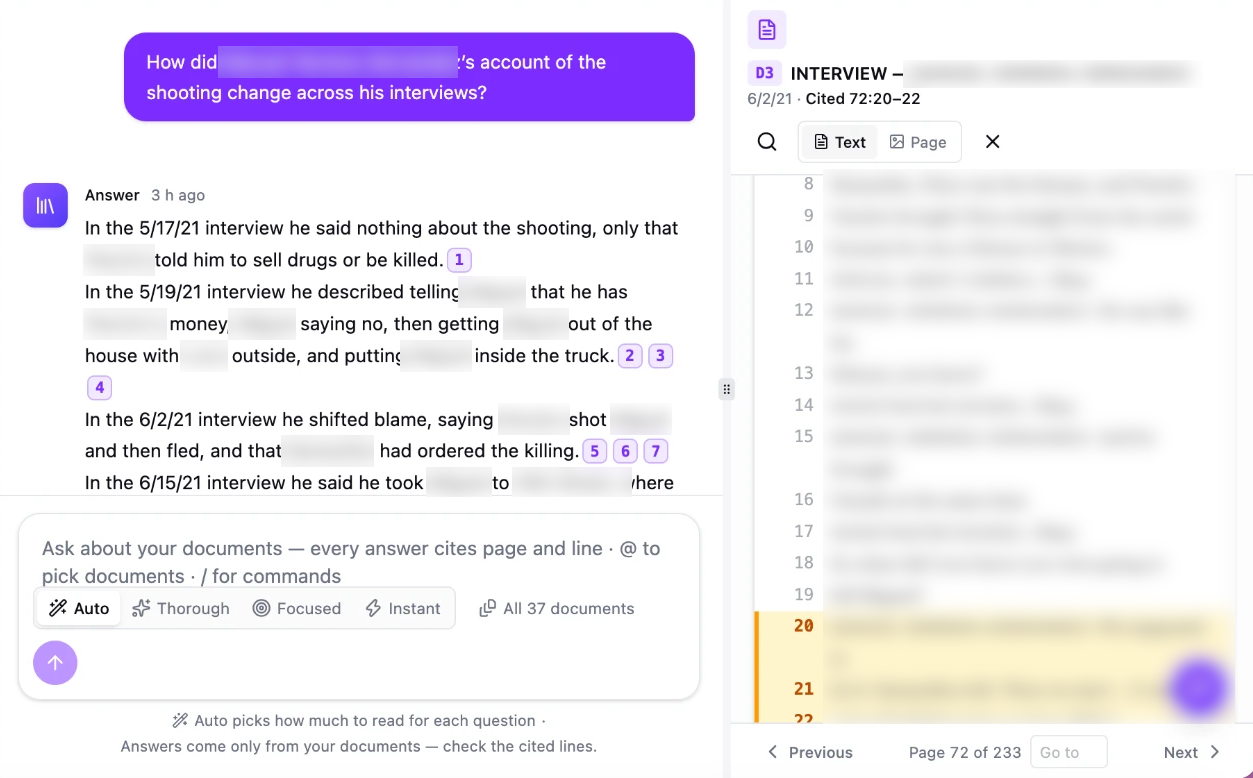
Each case is a private workspace on Ai-MicroCloud®. Ask in plain language; every answer comes back cited.
Checked, then scored
Quotes matched word for word; every answer carries a confidence score.
Case notes
Every page read in rounds, so instant answers usually come back in under a minute.
Any jurisdiction
Federal, state, county or city: attach the laws that apply. Federal Justice
The evidence is everywhere. The truth is not.
Many formats
Reports, warrants, messages, financials, images, audio and video.
Manual review
Facts spread across systems, correlated by people under deadline.
High sensitivity
Premature disclosure can compromise an investigation.
Ask the investigation. Trace every answer.
Timeline reconstruction
Every event points back to its source.
Cross-evidence analysis
People, devices, accounts and places, connected.
Legal reference matching
Fact patterns compared with approved statutes and guidance.
Contradiction & gap review
Inconsistent statements and missing intervals, surfaced.
Multimodal investigation
Text, audio, images and video, in one view.
Enterprise chat experience
Follow-up questions, straight to the cited evidence.
Ask in plain language.
“What happened, what evidence supports it, what contradicts it, which laws may be relevant, and what should we investigate next?”
One private workspace for the whole investigation.
Ingest
Bring authorized data into the controlled environment.
Understand
Extract entities, events, statements and timestamps.
Correlate
Connect records, people, places, devices and media.
Assess
Compare the fact pattern with approved references.
Verify
Review citations, contradictions and open questions.
From manual review to evidence-grounded insight.
Evidence search
Ask across authorized evidence, then go to the cited source.
Timeline building
A candidate timeline with records and gaps flagged.
Legal issue spotting
Potential citations returned for counsel review.
Contradictions
Inconsistencies, mitigating evidence and open questions.
Sensitive data
Evidence, prompts and inference stay in your boundary.
Repeatability
Consistent prompts, traceability and audit practices.
Days → hours
Initial evidence orientation.
One query
Across approved evidence.
Source-backed
Findings for human review.
Important: time savings depend on data quality, model configuration, review standards and case complexity. Justice AI supports investigation and legal research; it does not determine guilt or replace qualified counsel.
Bring AI to the evidence. Never the reverse.
Inside an enterprise-controlled security boundary, not a public AI service.
Authorized users
Role-based access for investigators, prosecutors and counsel.
Justice AI workspace
Matter-level controls and evidence-grounded answers.
Private AI services
Models, retrieval and vector stores, inside the boundary.
Investigation & reference data
Case evidence, law libraries and approved guidance.
Enterprise security boundary
Identity, encryption, logging, retention and isolation.
What the private architecture protects.
Protect people
Less risk of exposing victims, witnesses and uncharged individuals.
Protect the case
Control of evidence, prompts, model access and responses.
Protect the process
Source traceability and human verification.
Controls that matter.
Identity and roles
Authorization at user, matter and repository level.
Encryption
In transit and at rest, with enterprise-controlled keys.
Private inference
Including isolated or air-gapped environments.
Audit-ready logging
Access, queries, sources and outputs.
Data lifecycle
Aligned with evidence handling, legal hold and records.
AI assists. Investigators decide.
Every material output stays reviewable, source-grounded and under established legal authority.
Presumption & fairness
References to possible crimes are leads, not conclusions of guilt.
Source verification
Inspect the underlying record before relying on a finding.
Legal oversight
Probable cause and charging stay with authorized professionals.
Access & purpose limits
Each matter restricted to approved users, data and purposes.
Model & prompt governance
Tested for accuracy, bias, hallucination and security.
Auditability
Activity records fit for evidentiary process and oversight.
A practical pilot.
One bounded matter, approved evidence, a small group of investigators and counsel.
Scope
Select one matter and approved data.
Secure
Deploy inside the chosen boundary.
Validate
Test timelines, citations and source links.
Measure
Compare time, quality and reviewer effort.
Own the investigation. Own the AI.
Justice AI by Zeblok. Private investigative intelligence for the enterprise.